


Thinking of giving your house or land to your son, daughter, or spouse? You might be planning to use a gift deed, which is a common way to do it.
But between the legal rules, gift deed stamp duty charges, and the e-stamp process for gift deed, the whole thing can get confusing fast.
This guide cuts through all that. We'll walk you through the entire online e-stamp process for gift deed, explain exactly how much stamp duty on gift deed to son/daughter/spouse will cost you, and show you how to pay online without hassle.
Let's get started.
What Is a Gift Deed?
A gift deed is a legal document to voluntarily transfer property ownership without payment, commonly used for immovable assets like houses/land to family members such as sons, daughters, or spouses.
A gift deed is a legal document you use to give your property to someone else without taking money. It is a voluntary transfer where the receiver gets ownership as a gift.
Here's what this means:
- The person giving the property does so voluntarily
- No sale or payment involved from receiver
- Commonly used to transfer houses, land to family members
Who Are Donor and Donee in Gift Deed?
The donor is the giver (current owner, acting voluntarily), and the donee is receiver who must accept during donor's lifetime for validity.
Every gift deed has two main parties:
- Donor: Person giving gift (current owner, sound mind, love/affection)
- Donee: Person receiving gift (must accept while donor alive)
Simple: Donor Gives, Donee Gets.
What Types of Property Can Be Gifted via Gift Deed?
Immovable (land, buildings) and movable property (jewelry, vehicles, shares) if fully owned, dispute-free, with co-owner consent if applicable.
Law allows gifting two main types:
1. Immovable Property (Property that does not move):
- Land (plots, agricultural land)
- Buildings (houses, apartments, shops)
This is the most common use for gift deeds within families.
2. Movable Property (Property you can move):
- Jewellery
- Vehicles (cars, bikes)
- Shares, Stocks, or Bonds
- Art and other valuables
*Important to remember:
- Only property you fully own now
- No future property
- No legal disputes
- Co-owner consent required
Now, just wanting to gift something to someone isn't enough. There are some strict legal rules you must follow for the gift to be valid.
Let's see what they are.
What Are Legal Rules for Valid Gift Deed in India?
Under Transfer of Property Act 1882: Full party/property details, voluntary, no consideration, donee acceptance during donor life, registration + stamp duty for immovable property.
Key rules from Transfer of Property Act, 1882:
1. Mandatory Requirements:
- Names and Relationship: The deed must clearly have the full names, addresses, and relationship of the donor and donee.
- It must be your choice: The gift has to be voluntary. No one can force or pressure the donor to sign it.
- Clear Ownership: The donor must have clear and legal ownership of the property. You cannot gift something that is not fully yours or is in a legal fight.
- Describe the property fully: You must give a precise description of the property like survey number, address, boundaries, so there is no confusion.
- No money involved: The deed must clearly say the transfer is made out of love and affection, with no money or payment exchanged.
- Acceptance while alive: The donee must accept the gift while the donor is still alive. If the donor passes away before acceptance, the gift is void.
2. Mandatory Registration: For immovable property (like land or house), registration at the sub-registrar's office is compulsory by law.
- Stamp Duty Payment: You must pay stamp duty. The amount changes from state to state.
- Only present property: You can only gift property that exists now. You cannot gift a property you might get in the future.
- Transfer of Possession: The deed should say how and when the physical possession of the property is handed over to the donee.
- Two Witnesses: The deed needs to be signed by at least two witnesses who attest to it.
- Revocation Clause (Optional): You can add a clause on how the gift can be cancelled, but this is not required by law. Adding it can stop future fights.
A gift deed is a serious legal document with fixed rules. The most critical steps that come next are paying the stamp duty and registering the deed.
Let's understand the first major cost: the stamp duty.
Stamp Duty on Gift Deed: A Complete Guide
Stamp duty is a government tax you must pay on the gift deed to make the property transfer legal. If you don't pay it, your gift deed can be rejected, you might have to pay a penalty, and the transfer will not be valid in the eyes of the law.
This duty is how the government records the transaction and collects revenue, even though no money is being paid between you and the receiver.
Now, let's break down exactly what this means for you.
What is Stamp Duty and Why is it Mandatory?
Stamp duty is a tax on the gift deed, calculated as a percentage of your property's market value. You must pay this tax to the government to make the gift deed legally valid.
Here is why you cannot avoid paying stamp duty:
- Legal proof: Paying the stamp duty is the official proof that the property ownership has been transferred.
- Government record: It puts the transaction in government records.
- Stops future fights: A properly stamped deed reduces the chance of someone challenging the gift later.
- Required by law: The Indian Stamp Act makes it compulsory. Not paying is breaking the law.
In short, no stamp duty payment means your gift deed is only a piece of paper with no legal backing.
How Stamp Duty is Calculated for Gift Deeds
To calculate stamp duty, multiply your property's market value by the stamp duty rate of your state. The rate changes depending on where your property is.
The main things that decide your stamp duty amount are:
1. Market value of property: This is the current price your property would sell for. The sub-registrar's office or a certified valuer can give you this value.
2. State government rules: Every state in India has its own stamp duty rate. For example:
- Maharashtra: 3%
- Delhi: 6%
- Karnataka: 5%
- Tamil Nadu: 7%
3. Relationship with receiver: This is very important. Most states charge much lower rates if you are gifting to close family.
Formula: Stamp Duty = Property Market Value x (Your State's Stamp Duty Rate / 100)
Example: If a property in Maharashtra is worth ₹1 Crore and the stamp duty rate is 3%, the duty is ₹30,00,000 (1,00,00,000 x 3/100).
What Are Stamp Duty Exemptions/Concessions?
Many states offer big discounts or full exemptions on stamp duty if you gift property to close relatives. This is to make it easier for families to transfer assets.
Who is usually considered a "close relative" for lower charges?
- Spouse
- Children
- Parents
- Siblings
Examples of state concessions:
- Maharashtra: You may pay only ₹200 as stamp duty for gifts to spouse, children, or grandchildren.
- Karnataka: The duty is a small fixed amount (like ₹1,000) for family transfers instead of a percentage.
- Delhi, Uttar Pradesh, etc.: The rates are generally lower for blood relations compared to gifting to a friend or distant relative.
What you need to do: You must show proof of your relationship (like a marriage certificate, birth certificate) to claim this lower rate when you pay the duty.
Knowing the cost is one thing. Now, let's see how you actually pay this stamp duty online through the e-stamp process.
How to Generate E-Stamp Paper Online for Gift Deed (2026)?
Visit SHCIL/stockholding.com or state portal → Enter property details/value/relationship → Pay UPI/net banking → Download e-stamp certificate + UIN for registration.
NEW 2026 Process (20+ states):
Step 1: Visit SHCIL (stockholding.com) or state portal
Step 2: Select "Gift Deed" → Enter property details
Step 3: Input market value + relationship (family concession)
Step 4: Calculate/pay stamp duty (UPI/Net banking)
Step 5: Download e-stamp PDF + Unique Identification Number (UIN)
Step 6: Verify UIN on portal (QR code)
Validity: 6-12 months, sub-registrar verifiable.
What Is Step-by-Step E-Stamp Payment Process?
You pay stamp duty for a gift deed online through e-stamping, with physical stamp papers, or by franking at banks. The steps are the same no matter which method you choose.
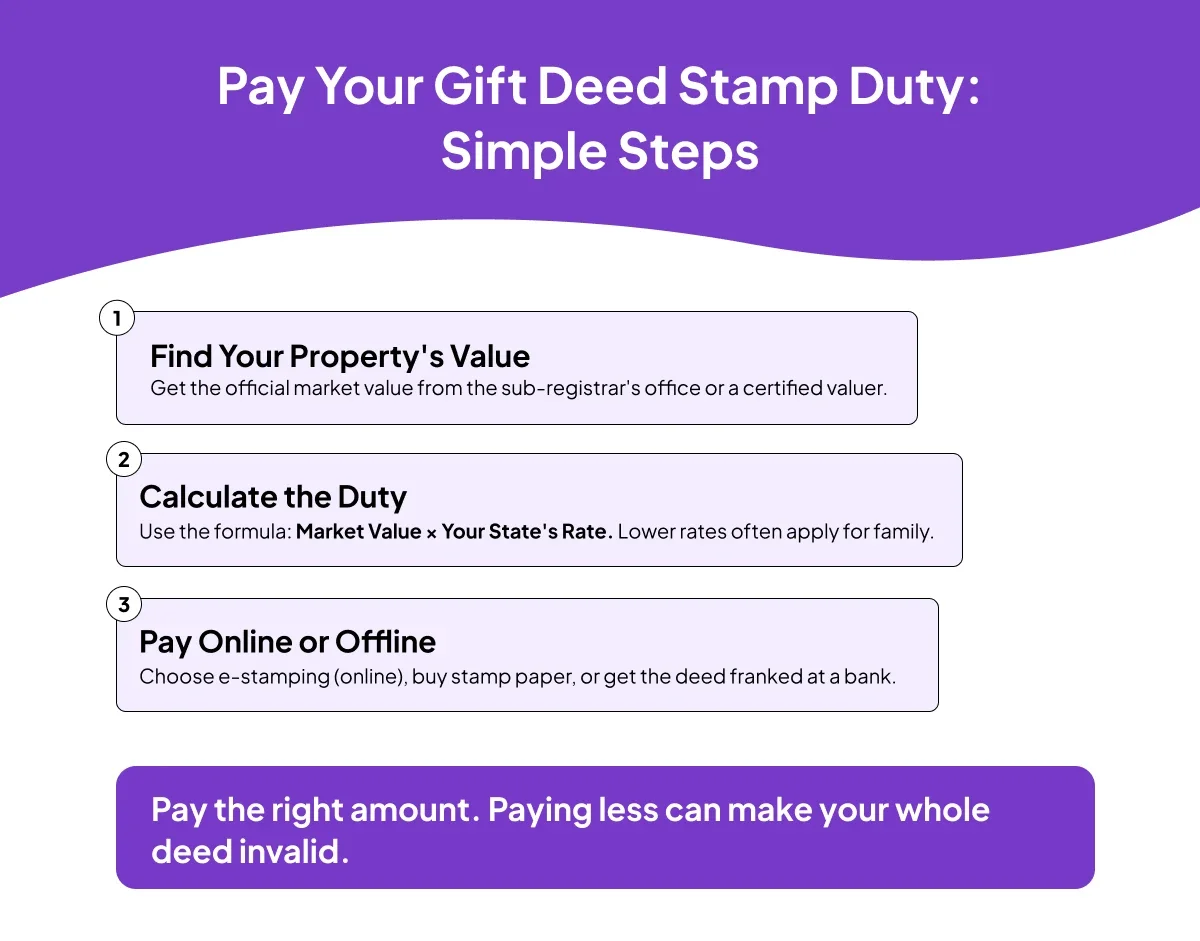
Here is the simple procedure you need to follow:
Step 1: Find Out Your Property's Value
Go to your local sub-registrar's office or hire a certified valuer. They will tell you the official market value of your property. This is the number you will use for all calculations.
Step 2: Calculate the Stamp Duty Amount
Use the formula: Stamp Duty = Market Value of Property × (Your State's Stamp Duty Rate / 100). Remember, the rate is lower if you are gifting to close family.
Step 3: Pay the Stamp Duty
You have a few options to pay:
- E-Stamping: Do it online through your state's official e-stamping portal.
- Physical Stamp Paper: Buy non-judicial stamp paper of the correct value from an authorized vendor.
- Franking: Go to a designated bank, pay the duty, and they will frank your deed document.
Do not pay less than the correct duty. If you pay less, your entire gift deed can become invalid later.
Before you can register the deed, you need to get your documents ready.
So, let's now look at exactly what papers you will need for the e-stamping and registration process.
What Documents Required for E-Stamping & Registration?
You need a set of documents for e-stamping and registering your gift deed. Having all these papers ready before you go will save you time and stop the process from getting stuck.
Here is the checklist of documents you must collect:
1. For the Donor and Donee:
- ID Proof: Aadhaar card, PAN card, Voter ID, or Passport.
- Address Proof: A recent electricity bill, phone bill, or rental agreement.
- Passport size Photos: Two recent photos each.
2. For the Property:
- Original Gift Deed: The main document, correctly written and signed.
- Proof of Ownership: Papers that show the donor owns the property, like the old sale deed, property tax receipt, or title deed.
- Encumbrance Certificate: A paper from the registrar's office that proves the property has no legal cases or loans against it.
3. For the Two Witnesses:
- Witness ID Proof: Aadhaar card, PAN card, or Voter ID of both witnesses.
- Witness Address Proof: A recent utility bill or other valid address proof for both witnesses.
- Other Papers (If needed):
- No Objection Certificate (NOC): You might need this if the property is agricultural land or if there is a home loan on it.
A good practice is to make two photocopy sets of every document. The sub-registrar's office will need to see the originals and often keeps the copies for their file.
Once your documents and e-stamp are ready, the final step is registration.
Let's look at the registration charges and the final steps to make your gift deed 100% legal.
What Are the Total E-Stamp and Registration Charges for Gift Deeds?
The total government charges for a gift deed are the stamp duty plus the registration fee. These are two separate payments you must make to complete the legal transfer. The cost changes a lot depending on which state your property is in.
1. Stamp Duty Charges (State wise Rates for Gift Deeds):
Rates 2-7% of market value; family concessions to ₹200-₹5000 (e.g., Maharashtra 3% or ₹200 to son); registration 1% nationwide.
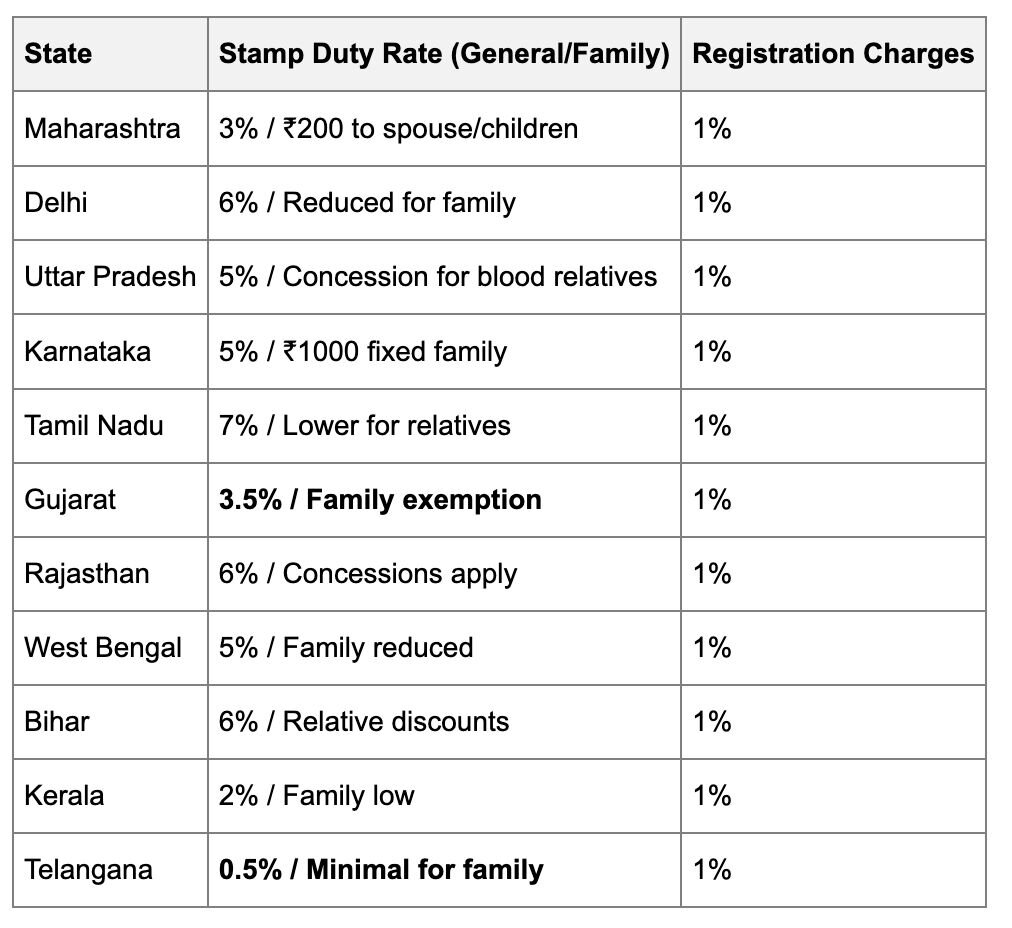
Note: These rates are often much lower if you gift to close family like a spouse, parents, or children. You must show relationship proof.
2. Registration Charges:
This is the fee to officially record the deed in the government's book. For almost all states in India, this charge is 1% of the property's market value.
How to Calculate Your Total Cost:
Let's say your property in Maharashtra is worth ₹1 Crore and you are gifting it to your son.
- Stamp Duty: With a family concession, you might pay only ₹200 instead of 3% (₹3 Lakhs).
- Registration Charge: 1% of ₹1 Crore = ₹1,00,000.
- Total Government Charges: ₹200 + ₹1,00,000 = ₹1,00,200.
If you were gifting the same property to a friend, the cost would be much higher: ₹3,00,000 (Stamp Duty) + ₹1,00,000 (Registration) = ₹4,00,000.
The Final Step
After you pay the stamp duty (via e-stamp) and have all your documents, you must go to the sub-registrar's office. The donor, donee, and two witnesses need to be there. You will submit all papers, pay the 1% registration fee, sign the deed in front of the registrar, and get a certified copy. This copy is your final legal proof.
The gift is now legally complete. But what happens when it's time to file taxes?
Let’s understand the income tax rules for gifted property.
What Are the Income Tax Implications on Gifted Property?
Tax-free from relatives (spouse/children/parents/siblings), >₹50K from non-relatives taxable as income, future sale uses donor's cost basis for capital gains.
If you receive a property as a gift, you might have to pay income tax on it, but only if the giver is not a close relative. The person giving the gift does not pay any tax for making the gift. The tax rules depend entirely on who is giving you the gift.
Gifts from close relatives are completely free from income tax. The Income Tax Act says that if the gift is from your spouse, parents, siblings, or your children, you don't have to pay any tax on it. It doesn't matter how expensive the property is.
However, if you get a gift from someone who is not a close relative like a friend, a cousin, or a business partner, then different rules apply.
If the total value of the gift you receive from them in a year is more than ₹50,000, then the entire amount becomes taxable for you. This amount gets added to your yearly income, and you pay tax according to your income tax slab.
You also need to remember the capital gains tax for the future. There is no tax when you receive the gift. But if you sell the gifted property later, you will have to pay capital gains tax.
The government calculates your profit from the original price the donor paid, not from when you got it for free. This can lead to a higher tax bill, so you must keep the donor's original purchase papers safe.
Now that you know the rules and costs, let's look at why using a gift deed can be a smart move.
What Are the Advantages of Using a Gift Deed?
Provides legal proof, prevents disputes, saves on family stamp duty, enables lifetime planning, and confirms voluntary intent without sale consideration.
Using a gift deed makes transferring property to family simple, legal, and often cheaper. It’s a clear way to give an asset as a true gift, with benefits for both the giver and receiver.

Here are the main advantages:
- Clear legal proof: The gift deed is a legal document that acts as solid proof the property has been transferred. It removes any doubt about who the new owner is.
- Stops family disputes: Once registered, it prevents other relatives or people from making a claim on the property later. This helps avoid future disputes and ensures your wishes are followed.
- Good for planning: It lets you decide who gets your assets during your lifetime, making succession smooth and clear.
- Saves money on stamp duty: In most states, the stamp duty for a gift deed is much lower when you gift something to close family like parents, spouse, or children compared to selling the property. This makes it a cost-effective way to transfer ownership.
- Shows true intention: Since no money is exchanged, it clearly shows the transfer is made out of love and affection, not a business deal.
In short, a gift deed is a straightforward, legally sound, and often affordable method to gift property to your loved ones.
Frequently Asked Questions
1. What is a gift deed?
A gift deed is a legal paper you use to give your property to someone else as a free gift. No money changes hands. It’s a common way for families to transfer houses or land to children or relatives, making the transfer official and clear for everyone.
2. Is stamp duty payable on gift deeds?
Yes, absolutely. Stamp duty is a mandatory government tax you must pay on the gift deed to make it legally valid. The amount is a percentage of your property's value and varies by state. If you skip this payment, your gift deed won't hold up in court.
3. Can the stamp duty for a gift deed be reduced?
In most states, yes. If you gift the property to a close relative like your spouse, parents, or children, you often get a big discount or even pay a tiny fixed fee. Just remember to carry your relationship proof, like a birth or marriage certificate, when you go to pay.
4. Who pays the stamp duty in a gift deed?
The person giving the gift, called the donor, is responsible for paying the stamp duty. This is the rule because if the receiver paid, it would look more like a sale than a genuine gift, and that would mess up the whole legal point of the deed.
5. Is a gift deed required to be registered?
For immovable property like land or a house, registration at the local sub-registrar's office is compulsory by law. It’s the final step that puts the transfer on the government's books. Without that stamp in their register, the gift isn't legally complete, no matter what your deed says.
6. Is a gift deed taxable for the receiver?
It depends on who gave it. If it's from a close relative (like parents, spouse, siblings), then no, there's no income tax for you. But if a friend or distant relative gifts you property worth over ₹50,000, the full value becomes taxable income in your hands for that year.
7. What is the difference between a gift deed and a will?
A gift deed transfers property right now, while you're alive. A will only takes effect after you pass away. Think of a gift deed as handing over the keys today; a will is like leaving a note about who should get the keys later. Also, a registered gift deed is very hard to cancel, but a will can be changed anytime.
8. What is the stamp duty on gift deed to son in 2026?
₹200-₹5000 fixed in most states like Maharashtra with birth proof, general 3-7%.